
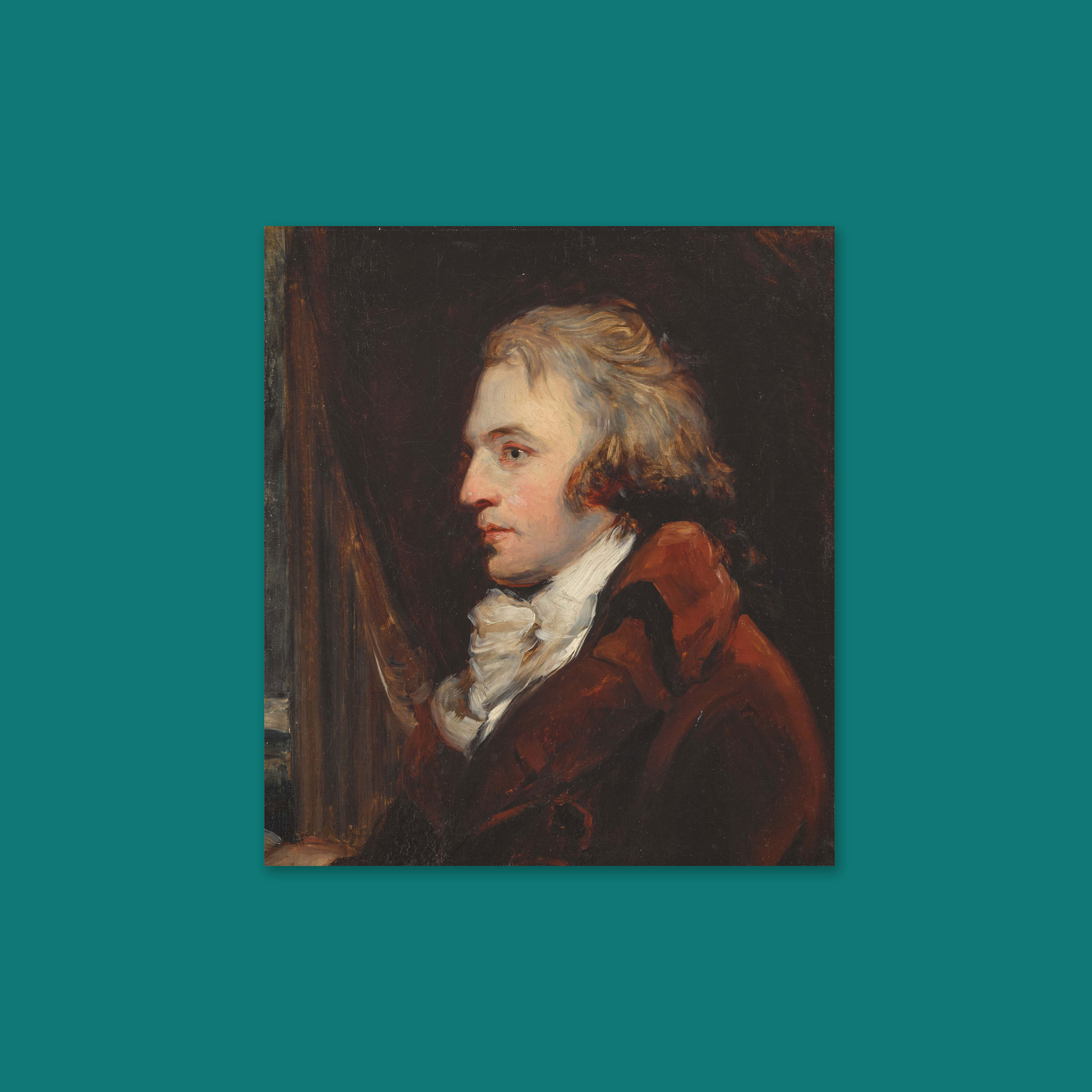
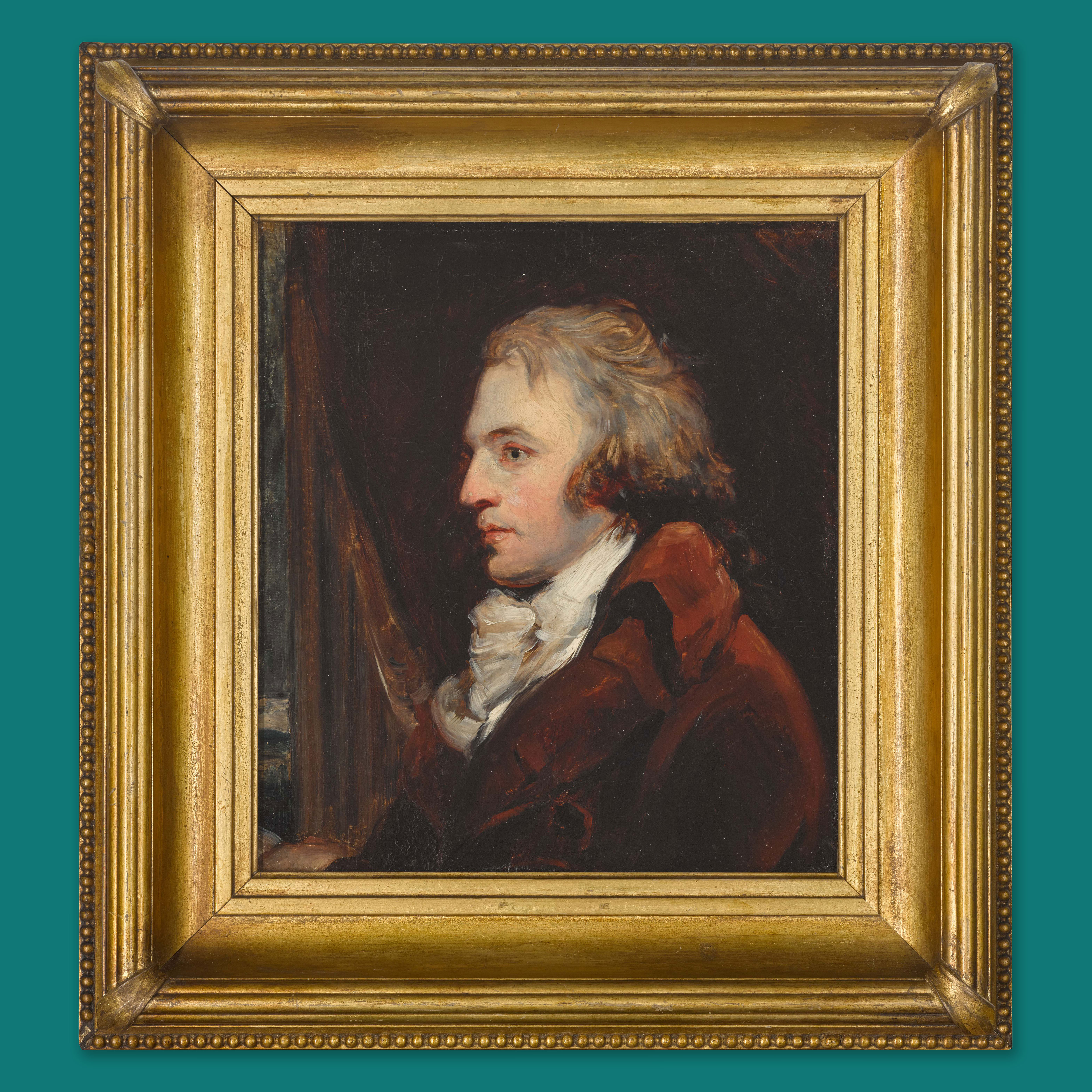

This compelling little study is a recent discovery that tells us much about one of the major portrait painters from the ‘golden’ period of portraiture in England at the end of the 18th and beginning of the 19th century.
Born to German parents, Hoppner found that he had an entrée into Royal circles at an early age, as his mother was one of a number of Germans who were attendants at the Hanoverian Court. Showing a considerable facility for drawing, he entered the Royal Academy Schools and it seems that the Prince of Wales (later George IV) took a patron’s interest in his career. Drawn initially to landscape, Hoppner found that portraiture was his surest method of earning a living. Throughout his career he would show numerous portraits at the R.A. with a good number of his sitters, through the offices of the Prince of Wales, coming from royal circles.
At the outset of his career Hoppner was heavily influenced by Sir Joshua Reynolds. Following Reynolds’ death in 1792 however, Hoppner began to develop his own individual style and found himself increasingly in demand. Today we view Hoppner as a portrait painter who was indeed touched with brilliance. While his drawing can occasionally be flawed, his best work shows a remarkable sense of colouring and even a certain romanticism, which has stood the test of time.
This delightful little work may be compared to Hoppner’s well-known self-portrait (c.1800) in London’s National Portrait Gallery – and also to Henry Singleton’s depiction of Hoppner in his famous 1795 group picture The Royal Academicians. In the latter, Hoppner is the figure standing at the extreme right of the group. In both pictures we note Hoppner’s aquiline features, his loose grey-powdered hair, his side-burns and his maroon coat. This present picture is a valuable and welcome addition to our knowledge of this highly competent painter’s appearance and his work.