
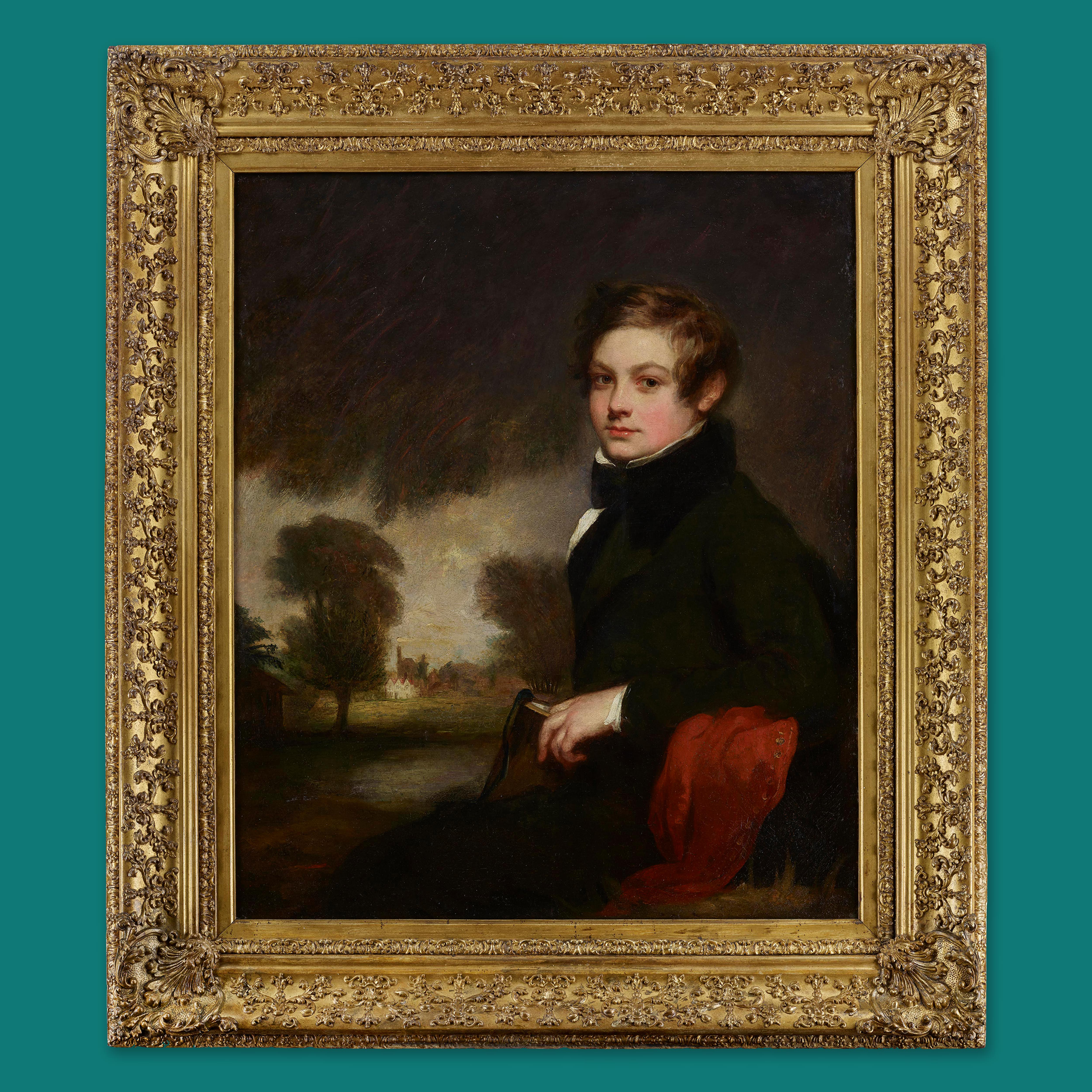

Original 'Lawrence style' gilt plaster frame
Margaret Carpenter is regarded as one of the most accomplished female portrait painters of her age. Born in Salisbury, the daughter of the painter A.R. Geddes, she was one of those artists naturally gifted from birth and she found that, even as a child, she was in demand for drawing portraits from families in the surrounding areas. Apart from some limited instruction, she developed her art mostly on her own.
Her earliest mentor was the Lord Radnor of the day who encouraged her to make copies from his collection at Longford Castle. Recognizing her talent, Lord Radnor financed her move to London in 1813 and remarkably, from the age of 20, she had set up her own portrait painting practice in the capital. Although it is hard to pin down her dates of pupillage, she does appear to have worked in the studio of Sir Thomas Lawrence at some stage, where she would have received some instruction and where she would have assisted with the drapery work in some of Lawrence’s paintings. Her output was impressive and between 1814 and 1866 she exhibited no less than 236 portraits in the major public exhibition venues – most notably at the Royal Academy, but also at the British Institution and at the Society of British Artists.
In 1817 she married William Hookham Carpenter, an academic and a museum curator. He became Keeper of Prints and Drawings at the British Museum and in 1852 both Carpenters took up residence in apartments at the museum itself. But despite the demands of married life and motherhood (there were eight children of whom five would survive), Margaret Carpenter saw that her contribution to the family’s finances would be vital. She felt she needed to give support not only to William but to her own parents as well. So with a thoroughly disciplined approach she maintained the output of her portraits with professional regularity. Her account book shows us that she had no less than 600 clients for whom she worked. William died in 1866 and Margaret effectively retired at that point when, in recognition of her husband’s work but also of her own achievements, she was awarded a pension by Queen Victoria. She died in 1872, by which time she could see that the artistic streak she had inherited from her own father had been passed down in turn to two of her children, who duly became artists in their own right.
Carpenter’s output is impressively varied. She could paint in watercolour, she could paint small scale intimate portraits yet was also undaunted by the three-quarter or full-length format for her oils. Thomas Lawrence was inevitably the guiding influence behind her style of painting and her compositions. But if she never quite reached the dazzling surface glamour that Lawrence could (indeed who did?), she brought an additional charm and psychological understanding to her sitters that can now be seen as something altogether her own. She painted the nobility, the wealthy mercantile classes, lawyers and judges, but she also painted those intellectuals and artists whose circles would have overlapped with hers. For example she is the artist who gives us our idea of what the painter Richard Bonington looked like and similarly the sculptor John Gibson.
For the context of this present portrait we need to look at Margaret Carpenter’s association with Eton College. The tradition of giving the college a leaving portrait seems to have come in part from the influence of the famous portrait painters Sir Joshua Reynolds and John Hoppner – the latter having in fact educated two sons at the College. This tradition would encourage boys to have their portraits painted and to leave them to the school. The painters who were entrusted with this exercise would often have some connection to the College. In Margaret Carpenter’s case, she was a friend of one of the more celebrated drawing masters at Eton, William Evans, a noted watercolourist in his own right. He seems to have been instrumental in proposing her to a number of sitters looking to follow in this tradition. Today there are some 30 works in oil by Carpenter in the College’s collection. On the back of this she developed a deserved reputation as a skilled painter of young men of that age. We do not know if our unknown sitter was an Etonian, but her treatment of him is so similar to a number of those College portraits that it will most probably have been her reputation there that secured her this commission.
The style of our painting is remarkably similar to a number of these young men. For further comparison one need only look at Carpenter’s fine likeness of the sculptor John Gibson in the National Portrait Gallery. Gibson is seated in an identically relaxed pose (in reverse), his eyes likewise turn to the viewer and the positioning and styling of his fingers are strikingly similar.
This picture is an excellent example of Margaret Carpenter’s work when she was at the height of her powers. She delivers an attractive young sitter engaging charmingly with the viewer. He is seated informally under a tree, with a view across an expanse of water to his home beyond. A portrait of this quality shows us immediately why Margaret Carpenter was held in such esteem in her lifetime – and also shows why there is a move today to bring her out of a century or so of obscurity and back into the limelight again.