
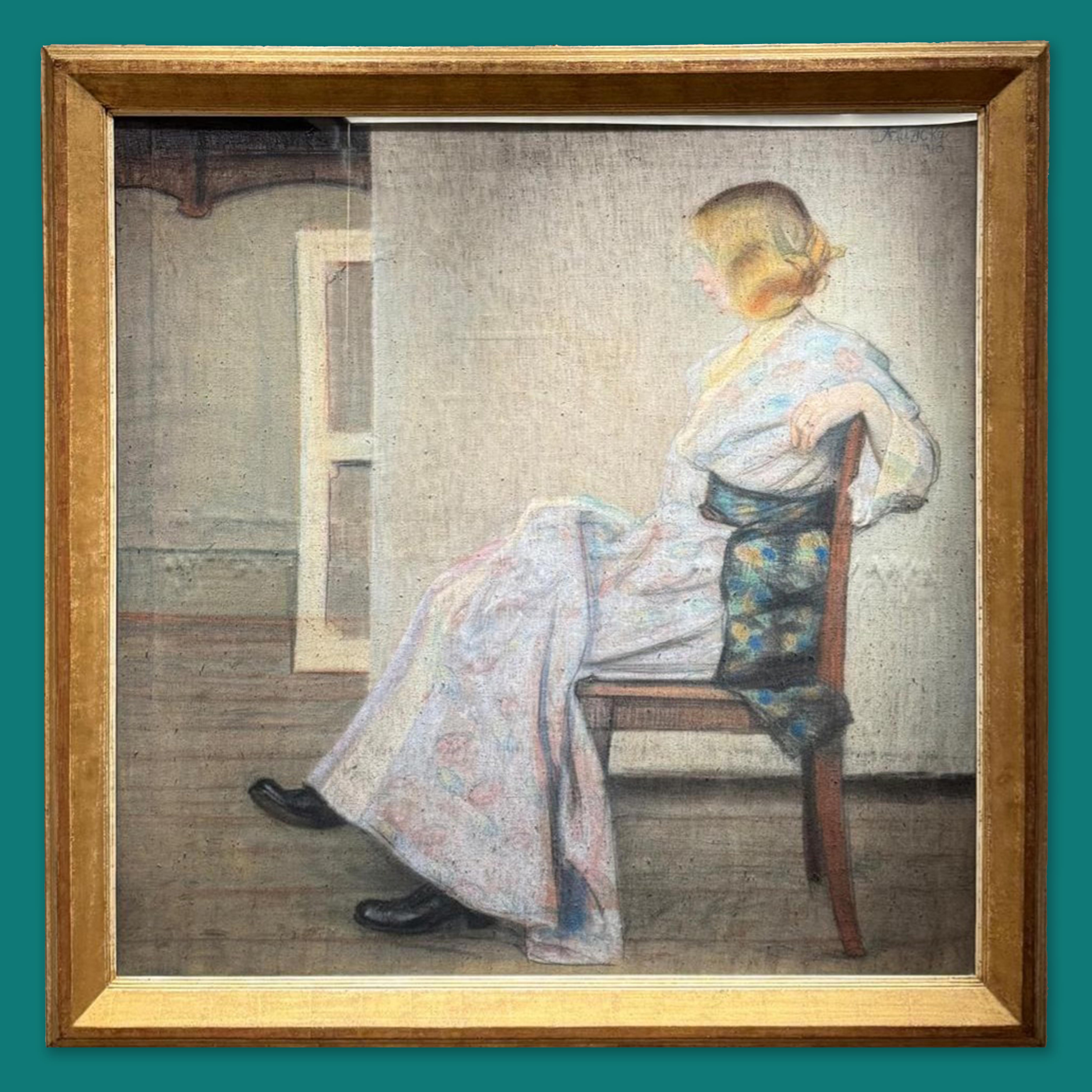

Sotheby’s London 1988
Private Collection
Othmar Ruzicka was a Viennese artist who is best remembered today for his devoted recordings of the ordinary inhabitants of Moravian Croatia and of Lower Austria. But there was another side to his art as this remarkable picture shows.
He was born in Vienna in 1877 and, showing an extraordinary facility with a pencil from an early age, was determined to pursue a career as an artist. So in 1896, defying his parents’ wishes, he enrolled at the Vienna Academy of Fine Art. He was a successful student, winning a number of prizes and one prize in particular which enabled him to travel to Italy to further his studies. Little travelled before, this scholarship opened his eyes to the possibilities that other cultures might hold for an artist. And it was not long before he found himself visiting the borders of Lower Austria and Moravia. Moravia would hold his attention for the rest of his life. In 1921 he married and in 1930 he finally moved with his wife and young son to Moravia itself. There he found the rest of his life’s work; the recording of the appearance of the traditionally dressed Croatians from that area. It is no exaggeration to say that without Ruzicka’s paintings of these subjects much of that culture would be unknown to today’s generations.
However, if Ruzicka was to become an observer of these fast disappearing Moravian customs, his early artistic output in Vienna was very different. We must remember that when he was a student in the 1890s, Vienna was a hotbed of artistic revolution which would propel the now world-famous artists such as Gustav Klimt and his fellow Vienna Secessionists to great international prominence. At the Vienna Academy, Ruzicka would have been taught by the more conservative sector of the Viennese artworld, but there is no doubting that this remarkable large-scale pastel signed by him and dated 1913 is redolent of the aims of the much more avant-garde artists of the city. The unusual and arresting profile pose of his model will be to all art-historians immediately suggestive of Whistler’s famous painting of his mother – his Arrangement in Grey and Black, now in the Musée d’Orsay. But this had been painted in 1871 and it is doubtful that Ruzicka would have seen it. However, in Vienna between 1900 and 1910 a number of artists, that other great Viennese artist Egon Schiele among them, had often taken Whistler’s pose and re-presented it in their own, now much more modern portraits. Ruzicka must have seen these pictures when they were shown at the Vienna Secession.
What we are looking at then is an ambitious stab at modernism by Ruzicka. His model – could it be the German girl he would marry later in 1921? – is seated in profile. Her head is deliberately not too clearly defined. She is being presented not as a portrait but simply as a ‘feminine figure’ to contemplate. The background is bare and uncluttered. The chair is simple, the boards are uncovered. There is just a plain screen pulled down to act as a back-drop and a canvas (we must be in Ruzicka’s studio) facing away from us against a wall. We are leaps and bounds away from the clutter of 19th century painting now. And if we look closely we can just see the interesting patterning of her dress – a dress made from the kind of fabric that was being produced by those art-conscious manufacturers of the time, such as the Wiener Werkstätte. Ruzicka, with his large and imposing pastel is momentarily aligning himself with the modernists of the Vienna art scene. Did he paint other pictures like this? Or did the First World War with its near complete decimation of the Austro-Hungarian Empire, blunt his modernist ambitions and lead him to seek refuge in more traditional forms of artistic expression? No matter. This is a compelling and beautiful canvas. And we should remember that here, in 1913, we are looking at something very modern – and of course very Viennese.